

 Английский язык
 Французский язык
 На испанском языке
 Русский язык
 Корейская народно-демократическая республика
 На японском языке
Rosemary Extract vs. Synthetic Antioxidants: Extending the Shelf Life of Plant Oils
Tighteningglobalregulations are forcing the edible oil industry to eliminate synthetic antioxidants- да- да- да. Chemical stabilizers like TBHQ, BHA,иBHT face strict European and North American bans or dosage limits due to clean-label mandates and consumer safety concerns.
Consequently, formulators must transition to natural alternatives. However, this shift introduces a severe industrial bottleneck: insufficient rancidity control in highly unsaturated lipid matrices.
For premium oils rich in polyunsaturated fatty acids—such as flaxseed, walnut, and sunflower oils—removing synthetic stabilizers accelerates lipid oxidation during transoceanic shipping. This causes exponential surges in peroxide values (POV) and costly batch rejections.
To bridge this performance gap while maintaining clean labels, manufacturers require a high-potency, oil-soluble solution. В настоящее время definitive answer lies in standardized 5% carnosic acid rosemary extract, a lipophilic polyphenol engineered to deliver equivalent oxidative protection in volatile plant lipids.
Chemical Comparison: Mechanistic Disruption of Lipid Oxidation
The degradation of vegetable oils occurs via a free-radical autoxidation chain reaction, targeting the weak allylic C-H bonds of unsaturated fatty acids. While synthetic antioxidants act as heavy-duty radical terminators, they are increasingly restricted due to bioaccumulation concerns and strict global dosage caps.
To evaluate natural alternatives, formulators must understand the structural mechanics of 5% carnosic acid. As a highly lipophilic phenolic diterpene, carnosic acid possesses a unique structure that allows it to dissolve uniformly within the lipid phase, establishing an active molecular shield directly at the oil-air interface.
Once oxidation initiates, carnosic acid undergoes a sequential cascade reaction, shifting into carnosol and other quinone derivatives while continuously scavenging lipid peroxy radicals. This continuous, multi-tiered protection mechanism allows it to disrupt autoxidation cycles efficiently at low inclusion rates.
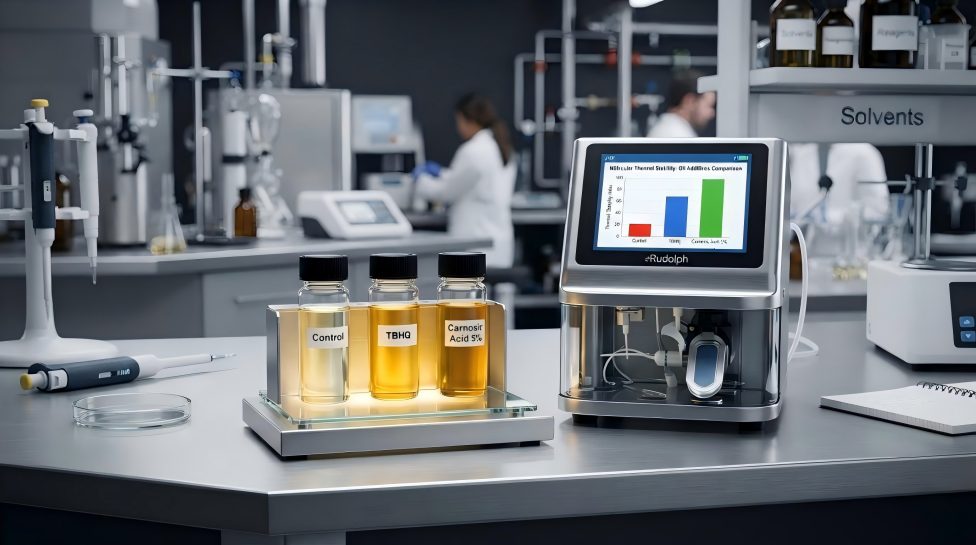
The technical specifications and industrial attributes of 5% carnosic acid versus traditional synthetic options are structured below:
Antioxidant Base | Solubility Profile | Molecular Heat Resilience | Label Designation | Secondary Processing Risks |
Synthetic TBHQ | Lipophilic | Low (Volatilizes above 100°C) | Chemical Additive | Evaporates during high-heat cooking/frying. |
Synthetic BHT / BHA | Lipophilic | Moderate | Chemical Additive | Strict dosage limits under global FDA/EU rules. |
Green Spring 5% Carnosic Acid | Highly Lipophilic | High (Thermally Stable to 140°C) | Natural Flavor / Extract | Zero clean-label blocks; retains high carry-through. |
Download HPLC Fingerprint Sheets & COA
Hard Data Evidence: Rancimat Accelerated Oxidation Testing
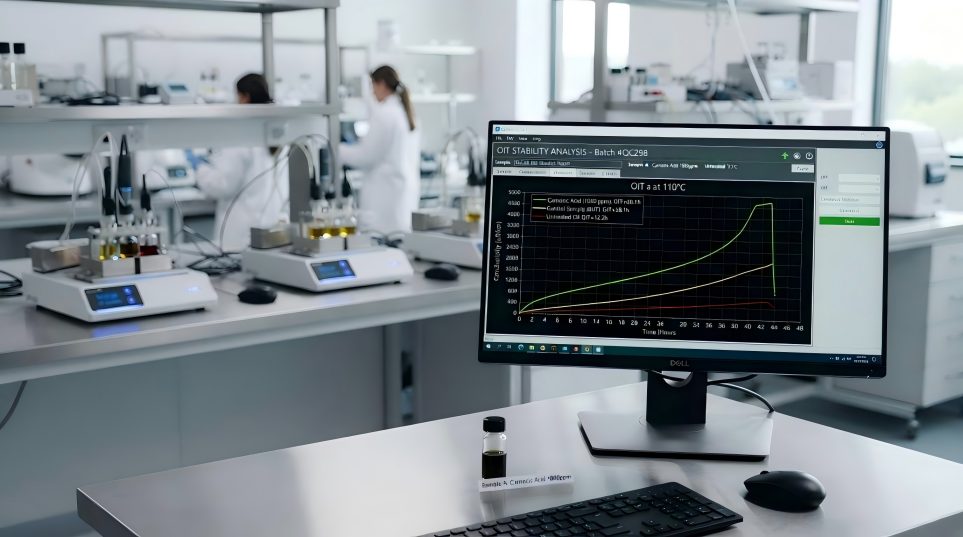
To prove the commercial viability of substituting synthetic additives, formulators require empirical, standardized stress testing. At Технология "зеленый источник", the performance of our 5% carnosic acid powder is strictly validated using the Rancimat Method (AOCS Cd 12b-92), the global baseline for mapping oil stability under extreme thermal and oxidative stress.
Our laboratory benchmarking focused on two highly volatile lipid systems: refined sunflower oil (susceptible to linoleic acid oxidation) and cold-pressed flaxseed oil (highly vulnerable due to massive alpha-linolenic omega-3 matrices). Both systems were exposed to a constant airflow at 110°C.
The definitive data from our recent Oxidative Induction Time (OIT) trials demonstrate that natural 5% carnosic acid directly competes with synthetic industry benchmarks:
Oil Carrier System (Tested at 110°C) | Control (No Additives) | BHT Stabilized (200 ppm) | TBHQ Stabilized (200 ppm) | Green Spring Carnosic Acid (200 ppm) |
Refined Sunflower Oil | 6.5 Hours | 14.8 Hours | 25.2 Hours | 23.9 Hours |
Cold-Pressed Flaxseed Oil | 2.1 Hours | 5.4 Hours | 9.2 Hours | 8.8 Hours |
The quantitative results verify that a minimal inclusion rate of 200 ppm of our standardized 5% powder boosts the oxidative resistance of sunflower oil by over 260%, outperforming BHT and tracking within a fraction of a percent of chemical TBHQ.
This data resolves the primary R&D concern regarding natural shelf-life extensions. By offering equivalent protection factors without the regulatory burdens of synthetic chemicals, our refined extract serves as an industrial-grade plug-and-play stabilizer for high-premium plant oil shipping and long-term warehousing.
Thermal Stability: The Carry-Through Advantage in High-Heat Refining
A major flaw of synthetic antioxidants like TBHQ and BHA is their vulnerability to thermal degradation. During industrial processes such as high-heat oil deodorization, vacuum distillation, or commercial deep-frying, volatile chemical stabilizers rapidly decompose or volatilize above 100°C, leaving the finished oil unprotected during post-processing storage.
В отличие от этого,Технология "зеленый источник"’s 5% carnosic acid powder delivers exceptional carry-through properties. Powered by its robust triterpenoid structure and refined molecular purification, our active component withstands manufacturing temperatures up to 140°C without chemical cleavage or vaporization.
Our thermal degradation metrics under steady high-temperature exposure are structured below:
Antioxidant Compound (Tested at 130°C) | Initial Active Concentration | Active Retention Rate (After 60 Mins) | Active Retention Rate (After 120 Mins) | Core Industrial Risk |
Synthetic TBHQ | 200 ppm | 62.4% | 41.8% | High thermal volatilization; leaves oil vulnerable to post-packaging rancidity. |
Synthetic BHT | 200 ppm | 71.1% | 52.3% | Moderate evaporation; strict dosage limits restrict high-heat deployment. |
Green Spring 5% Carnosic Acid | 200 ppm | 94.2% | 88.6% | Remains structurally physically stable; provides continuous carry-through protection. |
The data confirms that our natural extract preserves its physical stability under thermal stress, ensuring that the antioxidant matrix injected during bulk oil refining remains fully active in the final bottled product.
This thermal resilience prevents the need for post-cooling antioxidant re-dosing. For commercial oil refiners, this eliminates processing steps, lowers operational costs, and ensures uncompromised long-term shelf-life protection from the factory floor to the end consumer's kitchen.
Supply Chain Verification: Eliminating Global Regulatory Risks
Bulk vegetable oil importers face severe commercial threats from destination-port rejections due to uncertified supply chains, pesticide residue, or heavy metal contamination.
To eliminate these compliance barriers, Технология "зеленый источник" operates advanced extraction lines fully audited under global food-grade benchmarks: BRCGS Grade A and IFS Food.
Our corporate compliance standards and regulatory qualifications are structured below:
Supply Chain Asset | Verification Status | Sourcing & Compliance Value |
Manufacturing Quality | BRCGS Grade A | Top-tier processing safety; accelerates corporate vendor onboarding. |
Traceability Management | IFS Food Certified | Full batch transparency from fields to refined 5% powder. |
Global Market Access | FDA Registered & Non-GMO | Fully compliant regulatory dossiers for rapid customs clearance. |
Our rigorous batch screening ensures total alignment with strict EU and US FDA import rules:
Pesticide & Solvent Security: Advanced analytical purification guarantees ultra-low residues, bypassing international agricultural import traps.
Heavy Metal Mitigation: Lead, arsenic, and cadmium thresholds are controlled far below global food-grade safety ceilings.
Partnering with a 26-year source manufacturer allows your quality assurance (QA) team to streamline paperwork and skip expensive on-site pre-audits, securing a predictable, high-purity natural antioxidant supply.

Technical FAQ: Stabilization Solutions for Edible Oils
Our technical team addresses critical queries from vegetable oil refiners and quality control managers regarding synthetic-to-natural formulation transitions:
Q: Will 5% carnosic acid powder cause sedimentation or affect the clarity of refined plant oils?
A: в случае: в случае: в случае: в случае: No. At the recommended industrial dosage of 100–300 ppm, our standardized 5% powder solubilizes completely within lipid matrices. It maintains the original color, clarity, refractive index, and smoke point of premium refined oils.
Q: How does carnosic acid compare to TBHQ regarding sensory carry-through in frying oils?
A: TBHQ volatilizes rapidly at frying temperatures, releasing chemical degradation odors. Carnosic acid remains structurally stable up to 140°C, preventing the formation of hexanal and other volatile rancidity indicators without introducing any herbal aftertaste.
Q: Are Green Spring’s plant oil stabilizers compliant with strict EU heavy metal and plasticizer limits?
A: Yes. Under our BRCGS Grade A and IFS Food frameworks, every batch undergoes advanced gas chromatography-mass spectrometry (GC-MS) screening. We guarantee lead, arsenic, and plasticizer (DEHP/DBP) levels remain significantly below EU food safety ceilings.
Q: Can this 5% carnosic acid powder be direct-dosed into cold-pressed omega-3 rich oils?
A: Yes. For high-viscosity, cold-pressed oils like flaxseed or walnut, we recommend pre-dissolving the 5% powder into a small carrier batch of the target oil at 40°C to 45°C under constant agitation before introducing it to the bulk blending tank.
Initiate Plant-Scale Blending: Request Analytics & Testing Lots
Validating a natural alternative to TBHQ requires concrete physicochemical data and lot-specific industrial documentation. Green Spring Technology provides immediate, batch-certified analytical dossiers to streamline your vendor approval process and guide your initial refinery trials.
Align our technical support with your company’s immediate supply chain or formulation goals:
For Blending Engineers & R&D: [1[1]1[1]Secure a 20g Free Testing Lot] to run pilot-scale lipid solubility checks and internal Rancimat induction trials.
For Procurement & Quality Directors: [Access the Full Technical Dossier] to download product data sheets, solvent clearance specs, and direct factory price sheets for cost-in-use modeling.
Every industrial shipment is fully backed by audited BRCGS Grade A, IFS Food, and ISO22000 protocols, shielding your bulk edible oil distribution from international regulatory friction.
-
Предыдущий
Liposomal CoQ10 Powder: Solving Bioavailability Barriers in Anti-Aging Formulas
-
Следующий проект
Deodorized Rosemary Extract for Pet Food: Preventing Kibble Rancidity Without Affecting Palatability