

 Английский язык
 Французский язык
 На испанском языке
 Русский язык
 Корейская народно-демократическая республика
 На японском языке
The Ultimate B2B Quercetin Sourcing Guide: Purity, Particle Size, and Compliance for Global Brands
Inthe competitive global nutraceutical landscape, formulating a premium product with 1- да- да. Ответы на вопросы (Sophora japonica extract) involves significantly more than standard bulk procurement. For Research & Development (R&D) Managers, Formulation Scientists, and Quality Assurance (QA) Directors, Quercetin presents unique physical and chemical challenges.
From low oral bioavailability and poor water solubility to tablet capping and strict regional regulatory compliance, choosing the wrong grade of raw material can result in manufacturing bottlenecks, unstable shelf-life, or customs rejections.
This technical sourcing guide breaks down the critical physical parameters, chemical specifications, and regulatory baselines required to secure a high-performing, commercially successful Quercetin supply chain.
Chemical Specifications: Moving Beyond the 95% КЖПХ (HPLC) Baseline
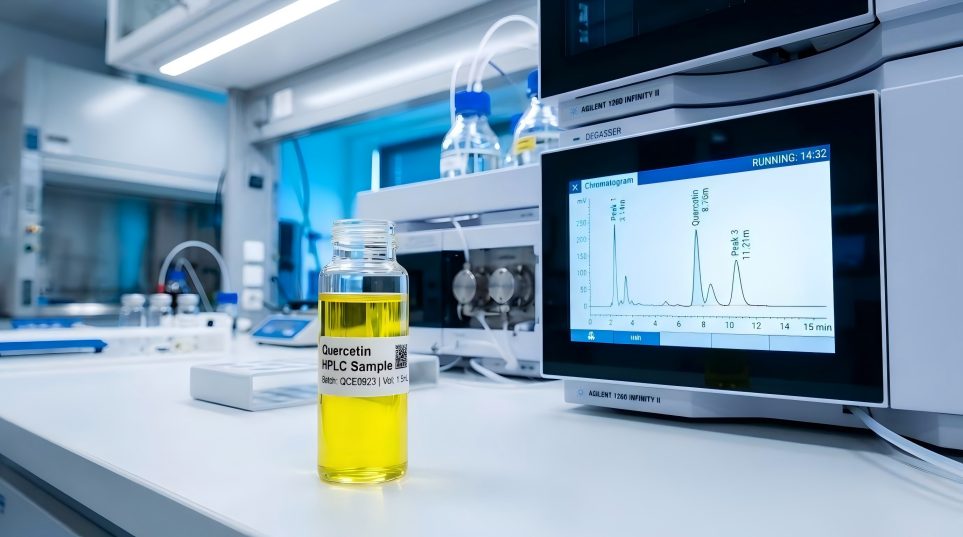
While the industry baseline for standard Quercetin Dihydrate is often loosely cited as ≥95% by High-Performance Liquid Chromatography (HPLC), premium global brands require a more rigorous chemical profile to ensure batch-to-batch stability and therapeutic efficacy.
The Problem of Flavonoid Carryover
During the hydrolytic extraction of rutin from Sophora japonica flower buds into Quercetin, incomplete conversion often leaves behind companion flavonoids such as rutin, isoquercitrin, and kaempferol. While these are natural polyphenols, their unstandardized presence alters the precise molecular weight calculations of your finished blend.
Premium Procurement Benchmark
Assay Profile: Demand an anhydrous basis purity of ≥ 98.0% HPLC.
Identity Verification: Ensure the supplier provides both Fourier-Transform Infrared Spectroscopy (FTIR) and Thin-Layer Chromatography (TLC) fingerprinting to confirm the absence of synthetic adulterants or botanical spiking.
Moisture Control: Standard Quercetin Dihydrate naturally carries 10%-12%bound water. For moisture-sensitive formulations (such as hygroscopic herbal blends or effervescent matrixes), sourcing Quercetin Anhydrous (≤1.0%moisture) is mandatory to prevent premature cross-linking in gelatin capsules or hydrolytic degradation of companion active ingredients.
Request a Third-Party Validated Sample Kit
Particle Size Engineering: Solving the Dispersibility & Tableting Dilemma
The mechanical behavior of Quercetin powder during manufacturing is heavily dictated by its solid-state properties. Raw, un-milled Quercetin consists of acicular (needle-like) crystals that exhibit poor flowability, high electrostatic charge, and extremely low bulk density.
Manufacturing Pain Points
Poor Flowability & Caking: Standard un-milled powder leads to uneven die-filling during high-speed tableting, resulting in severe weight variation and content uniformity failures.
Tablet Capping and Lamination: Due to the low compressibility of needle-like crystals, tablets often split horizontally (cap) when ejected from the press.
Sourcing Impact & Material Behavior (Copy-Paste Ready)
Standard Un-milled Crystals ➔ Poor Powder Flowability ➔ Weight Variation & Tablet Capping
Micronized / DC Granules ➔ High Bulk Density ➔ Uniform Die-Filling & High Mechanical Strength
Technical Solution by Application
Formulators must select the specific particle size topography tailored to their delivery system:
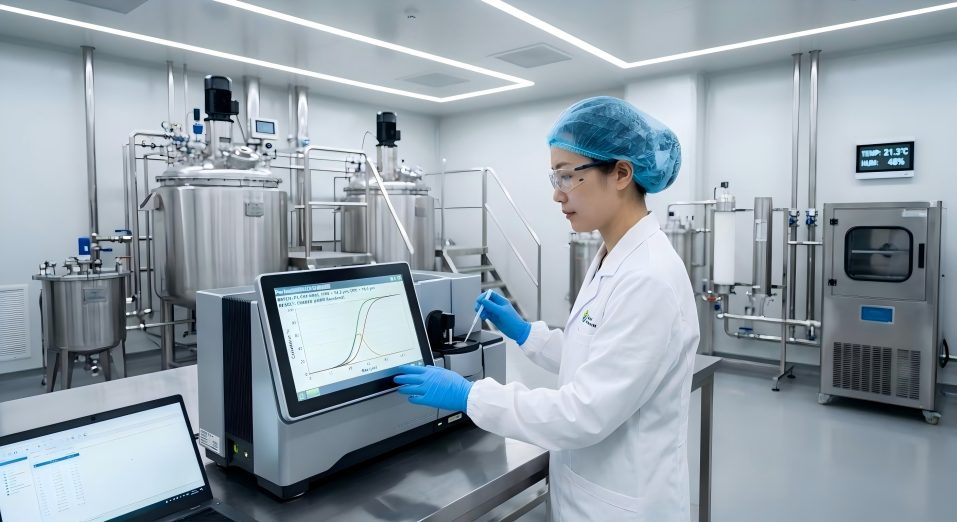
For Two-Piece Hard Gelatin Capsules: Utilize Micronized Quercetin Powder (D50≤10μm, D90≤25μm). Micronization dramatically increases the specific surface area, accelerating dissolution rates in the gastrointestinal tract and maximizing passive fluid diffusion.
For Direct Compression (DC) Tablets: Source Carrier-Free DC Grade Quercetin Granules (40–80 mesh). Granulated systems eliminate the need for excessive synthetic binders (like microcrystalline cellulose or dicalcium phosphate), allowing brands to achieve a Clean Label designation while maintaining excellent tablet hardness and low friability.
Solubility Breakthroughs: Formulating Sediment-Free Liquid Matrices
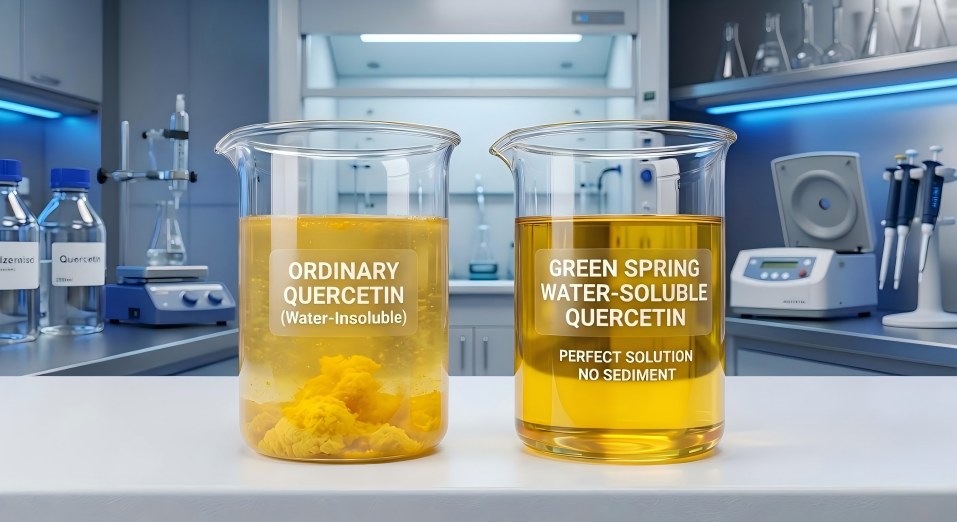
Quercetin is inherently lipophilic and practically insoluble in cold water (~ 2 mg/L at 25°C). When integrated into Ready-to-Drink (RTD) beverages, functional liquid shots, or syrups, standard Quercetin precipitates rapidly, creating unappealing sediment, cloudiness, and a bitter, astringent mouthfeel.
The Formulation Fix: Self-Dispersible Technologies
To conquer the thermodynamic barriers of liquid integration, premium sourcing relies on physical modification without chemical alteration:
Highly Dispersible Water-Soluble Systems: Through advanced micro-encapsulation or organic carrier-free spray-drying technologies, the surface energy of the Quercetin particle is modified.
The Result: Immediate dispersion in aqueous environments without forming agglomerates, ensuring a sediment-free, homogenous liquid phase ideal for high-throughput commercial beverage bottling lines.
Request Your Technical Sample Kit
Safety Baseline: Mitigating Compliance Vulnerabilities and Product Recall Risks
In the global nutraceutical supply chain, a botanical ingredient's contaminant profile represents either a critical financial liability or a distinct competitive advantage. For brand owners, R&D managers, and compliance officers, unmitigated heavy metals, residual solvents, or environmental pollutants mean far more than just missed quality metrics—they present immediate risks of catastrophic FDA 483 warning letters, mandatory market-wide product recalls, and irreversible damage to brand equity.
Residual Solvents (USP <467>)
Lower-grade manufacturing often utilizes toxic extraction solvents like methanol or acetone to maximize yield. Premium B2B sourcing mandates a strict Class 3 Solvent system (typically Ethanol-only processing). Residual ethanol should be controlled to ≤1,000 ppm, significantly beating the international ICH limit of 5,000 ppm to ensure pure, clean-label compliance.
Heavy Metals & Environmental Contaminants
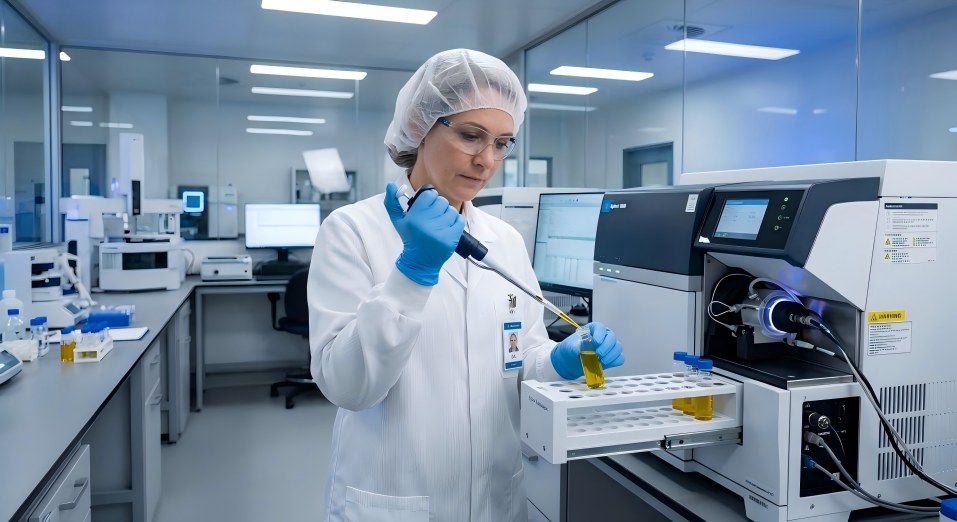
Потому что...Sophora japonica can bioaccumulate soil contaminants, rigorous batch validation via Inductively Coupled Plasma Mass Spectrometry (ICP-MS) is non-negotiable:
* * * * *Lead (Pb): ≤0.5 ppm
* * * * *Arsenic (As): ≤1.0 ppm
* * * * *Cadmium (Cd):≤0.5 ppm
* * * * *Mercury (Hg): ≤0.1 ppm
* * * * *Polycyclic Aromatic Hydrocarbons (PAHs): Ensure compliance with stringent European regulations (Regulation EU 2015/1933) with Total PAHs ≤50 ppb and Benzo(a)pyrene ≤10 ppb.
Technical Harmonization Matrix for Global Procurement Audits
To streamline your vendor validation process, use this standard technical specification index when auditing potential Quercetin manufacturers:
Technical Parameter | Standard Commercial Grade | Green Spring Premium Grade | Strategic Formulation Benefit |
Assay (HPLC, Dry Basis) | 95.0% - 97.0% | ≥98.0% Pure Active | Lowers excipient volume requirements in multi-ingredient premium complexes. |
Moisture Content | 10.0% - 12.0% (Dihydrate) | ≤1.0% Max (Anhydrous) | Prevents degradation in moisture-sensitive or hygroscopic powder blends. |
Residual Ethanol | ≤5,000 ppm | ≤1,000 ppm | Ideal for strict clean-label designations and sensitive liquid matrices. |
Total Heavy Metals | ≤10.0ppm | ≤3.0 ppm Max | Minimizes risk of heavy metal accumulation in daily multi-vitamin regimens. |
Pesticide Residues | Variable | Zero Detectable (USP <561>) | Ensures frictionless, automated customs clearance across US and EU borders. |
Secure a Frictionless Supply Chain with Технология "зеленый источник"
Navigating the complexities of premium Quercetin formulation requires an experienced, transparent partner. At Green Spring Technology, with 25+ years of continuous phytogenic extraction expertise, we eliminate the guesswork from your supply chain.
Our state-of-the-art manufacturing facility operates under rigid cGMP controls, delivering fully validated, third-party cross-tested Quercetin portfolios that comfortably meet and exceed USP, FDA, and EFSA standards.
We back every production lot with a comprehensive documentation package: Allergen Statements, TSE/BSE-Free Certificates, Kosher/Halal Compliance, and Non-GMO Project Declarations.
Request a Third-Party Validated 100g Quercetin Sample Kit
-
Предыдущий
Sophora Japonica Extract Quercetin for Premium Longevity Formulas
-
Следующий проект
Quercetin Regulatory Guide: FDA GRAS, EFSA & USP Standards