

 Английский язык
 Французский язык
 На испанском языке
 Русский язык
 Корейская народно-демократическая республика
 На японском языке
Anhydrous Quercetin Powder for Moisture-Sensitive Formulations
OvercomingCaking and Ingredient Degradation in Advanced Nutraceuticals
For R&D formulation scientists and contract manufacturing organizations (CMOs), selecting the right solid-state form of an active ingredient is critical to commercial viability. Quercetin, a premier flavonoid for immune and cardiovascular health, is frequently chosen for premium product lines. However, standard commercial lots—typically Standardized Quercetin Dihydrate Powder (95% - 98% HPLC)—carry up to 12% crystalline bound water within their molecular structure.
In modern, clean-label, or multi-ingredient delivery systems, this inherent moisture creates severe manufacturing bottlenecks. It drives reactive caking, delays disintegration times, and degrades sensitive co-ingredients.
At Green Spring Technology, with 25+ years of botanical extraction expertise, our engineering teams have resolved these processing vulnerabilities. By optimizing our thermal processing parameters, we provide a specialized solution: Quercetin Anhydrous Powder 98% (Ultra-Low Moisture Grade). This engineering grade is specifically built to guarantee stability in highly moisture-sensitive formulation matrices.
Process Technology Breakdown: Dihydrate vs. Anhydrous Quercetin
To help your formulation team assess the precise physical properties required for your manufacturing setup, we compare the two distinct crystal hydration states below:
Starting Material: Quercetin Dihydrate
Moisture Characteristics: Contains approximately 10% to 12% crystalline bound water.
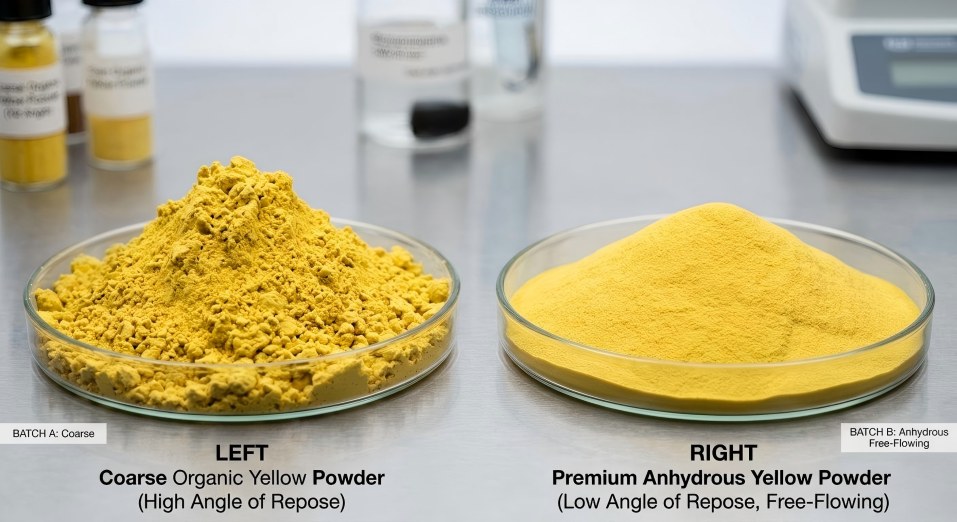
Processing Limitations: Poor powder flowability with high particle cohesion. Under the mechanical pressure and frictional heat of tableting or encapsulation, this bound water easily desolvates. This causes the powder to clump, stick to punches, and cake inside the machinery.
The Engineering Phase: Thermal Desolvation
A controlled vacuum thermal process that completely removes the volatile bound water molecules without breaking down the core flavonoid structure.
The Finished Grade: Quercetin Anhydrous
Moisture Characteristics: Total moisture content is strictly limited to under 1.0% (with actual commercial batches frequently testing below 0.5%).
Processing Advantages: Physically inert powder with a significantly lower angle of repose. It flows smoothly through high-speed hoppers and releases no residual moisture into the final blended matrix.
Request Free Samples for RD Test
Critical Formulation Failure Points Caused by Standard Dihydrate Material
1. Probiotic Micro-Environment Mortality & Enzyme Inactivation
Premium immune and gut-health supplements frequently pair quercetin with live probiotic strains (such as Lactobacillus rhamnosus), digestive enzymes, or highly hygroscopic co-actives like Vitamin C and SAMe. When standard Quercetin Dihydrate is subjected to mechanical compression, a portion of its bound crystalline water migrates. This free water breaks down the dry protective micro-environment around probiotics, leading to rapid cell death and accelerated vitamin oxidation over a short shelf-life.
2. High cohesive Force, Hopper Bridging, and Mass Variation
Quercetin Dihydrate crystals are needle-like and highly sensitive to ambient humidity. During continuous encapsulation runs, this high cohesive force causes the powder to bridge across hoppers or stick to the dosing disc. This leads to inconsistent capsule-filling weights and tablet thickness variations, forcing frequent machinery shutdowns and lowering your Overall Equipment Effectiveness (OEE).
3. Effervescent Pack Off-Gassing and Swelling
In water-soluble effervescent tablets or powder stick packs, the residual moisture from a dihydrate grade can prematurely trigger the internal acid-base reaction. This generates localized carbon dioxide (\(CO_{2}\)) outgassing inside sealed foil packaging, resulting in bloated, unmarketable consumer goods before they ever reach the store shelf.
Green Spring Technology’s Target Quercetin Portfolio for B2B Formulators
To ensure every R&D engineer can select the exact physical properties required for their delivery matrix, Green Spring Technology produces three distinct, compendial-grade portfolios:
Quercetin Anhydrous Powder 98% (Ultra-Low Moisture Grade)
Technical Properties: Total moisture is strictly capped at \(\le 1.0\%\) max via Karl Fischer testing.
Target Delivery Systems: Probiotic-blended capsules, multi-vitamin powder stick packs, effervescent tablets, and moisture-sensitive clean-label formulations.
Standardized Quercetin Dihydrate Powder (95% - 98% HPLC)
Technical Properties: High-purity, needle-like crystalline powder compliant with global pharmacopeia standards.
Target Delivery Systems: Conventional hard gelatin or HPMC capsule-filling and standard tablets where quercetin serves as a standalone monotherapy.
Highly Dispersible Water-Soluble Quercetin Powder (Food Grade)
Technical Properties: Utilizes natural food-grade carriers to modify surface energy, completely overcoming the hydrophobic nature of standard flavonoids without using synthetic solvents.
Target Delivery Systems: Ready-To-Drink (RTD) beverages, functional liquid shots, and dry beverage mixes requiring complete aqueous suspension without gritty sediment.
Comparative Specification Matrix for Procurement Quality Audits
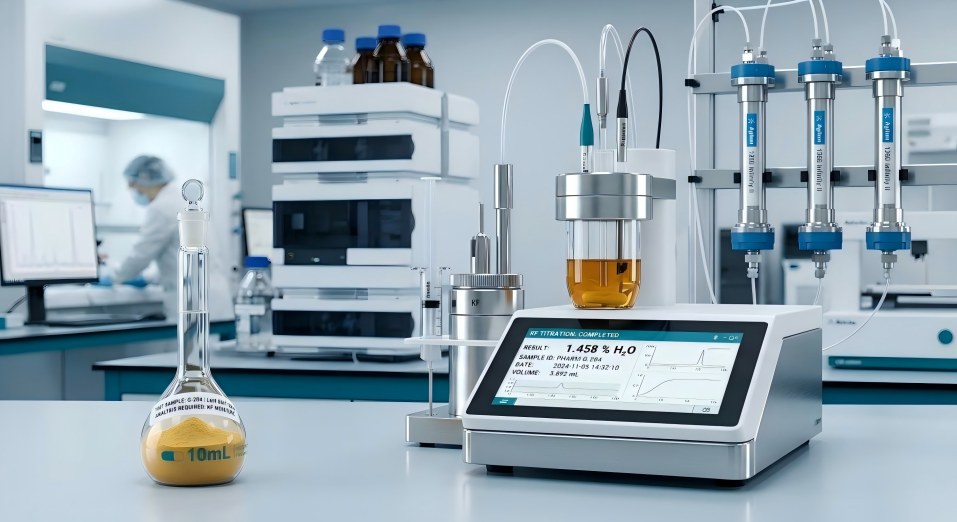
Every production lot from Green Spring undergoes strict qualification via High-Performance Liquid Chromatography (HPLC) and Karl Fischer titration to match stringent international compliance audits.
Parameter: Assay (HPLC, On Dried Basis)
Quercetin Dihydrate (95%-98%): (95.0% - 98.0%)
Quercetin Anhydrous (98%): (≥98.0%)
Water-Soluble Quercetin: Customized (10% - 20%) Active Flavonoid)
Parameter: Moisture Content (Karl Fischer)
Quercetin Dihydrate (95%-98%): (10.0% - 12.0%)
Quercetin Anhydrous (98%): (≤1.0%) Maximum (typically <0.5%)
Water-Soluble Quercetin: (≤5.0%)
Parameter: Powder Flowability (Angle of Repose)
Quercetin Dihydrate (95%-98%): Poor (>45°, prone to sticking)
Quercetin Anhydrous (98%): Excellent (<35°, free-flowing)
Water-Soluble Quercetin: Fair to Good
Parameter: Aqueous Dissolution Behavior
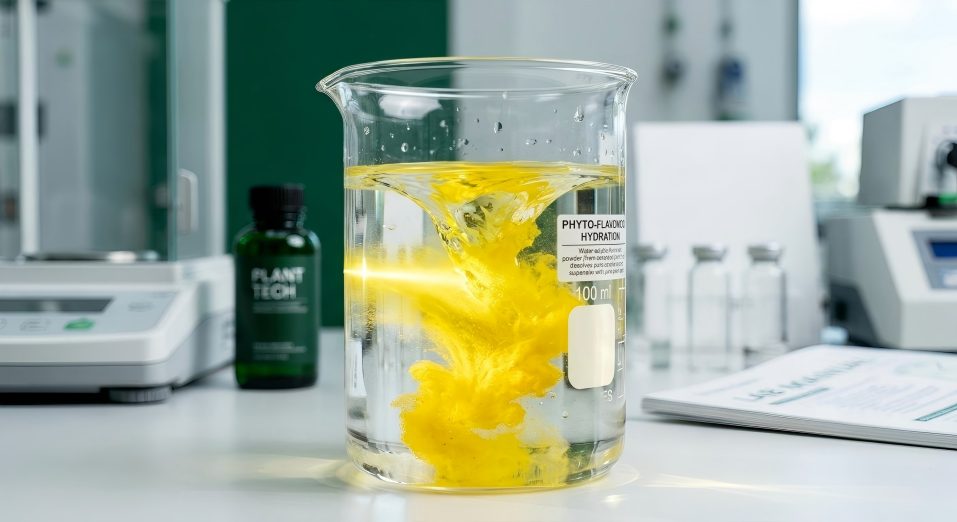
Quercetin Dihydrate (95%-98%): Hydrophobic; floats completely on the water surface.
Quercetin Anhydrous (98%): Hydrophobic; wets slowly and tends to clump in plain water.
Water-Soluble Quercetin: Spontaneous wetting; disperses rapidly into a stable, smooth suspension.
Parameter: Primary Packaging Control
Quercetin Dihydrate (95%-98%): Standard double-layer PE inner bags.
Quercetin Anhydrous (98%): Heat-sealed, high-barrier moisture-proof aluminum foil bags.
Water-Soluble Quercetin: Standard protective food-grade PE bags.
Secure Your Advanced Formulation Pipeline
Choosing between dihydrate and anhydrous grades can be the deciding factor between a stable 36-month shelf life and premature product degradation. Rely on Green Spring Technology’s 25 years of validated quality management, rigorous heavy metal screening, and third-party certified supply chain safety.
If you are looking to run pilot trials or optimize a sensitive recipe, let me know:
Which co-actives or sensitive ingredients (like probiotics or enzymes) are in your recipe?
What is your target delivery format (capsules, tablets, or powders)?
Do you require specific regulatory document packages like Allergen Statements, Kosher/Halal certs, or Non-GMO Project declarations?
I can instantly provide a comprehensive technical data sheet (TDS) or arrange a sample kit for your bench-scale validation.
-
Предыдущий
Quercetin Regulatory Guide: FDA GRAS, EFSA & USP Standards
-
Следующий проект
Carrier-Free DC Quercetin Launches for Clean Label Tablets